
May contain affiliate links. If you click through and make a purchase we may earn a small commission at no extra cost to you. Thank you for supporting The Great British Nook.
Scandi minimalist home decor is one of the most enduringly popular interior styles in the world. And it’s easy to understand why. It’s calm. It’s clean. It makes a room feel both simple and deeply considered at exactly the same time. Furthermore, it has that rare quality of feeling genuinely restful — a home that lets you breathe rather than one that demands your attention.
But what exactly is Scandi minimalist home decor? And how does it translate into an American home with a British twist? That’s exactly what this guide is here to answer. So take a breath. Clear a surface. And let’s start at the beginning.
What is Scandi minimalist home decor?
Scandi minimalist home decor is a design tradition rooted in the Nordic countries — Denmark, Sweden, Norway and Finland — that has been profoundly influential on British interior design for decades. It’s built on a set of core principles that are simple to understand but genuinely transformative when applied with commitment.
Those principles are these. First, every object in a room should earn its place — it should be either beautiful or useful, and ideally both. Second, natural materials are always preferable to synthetic ones. Third, light is precious and should be maximised wherever possible. Fourth and above all, a home should feel genuinely comfortable rather than simply impressive.
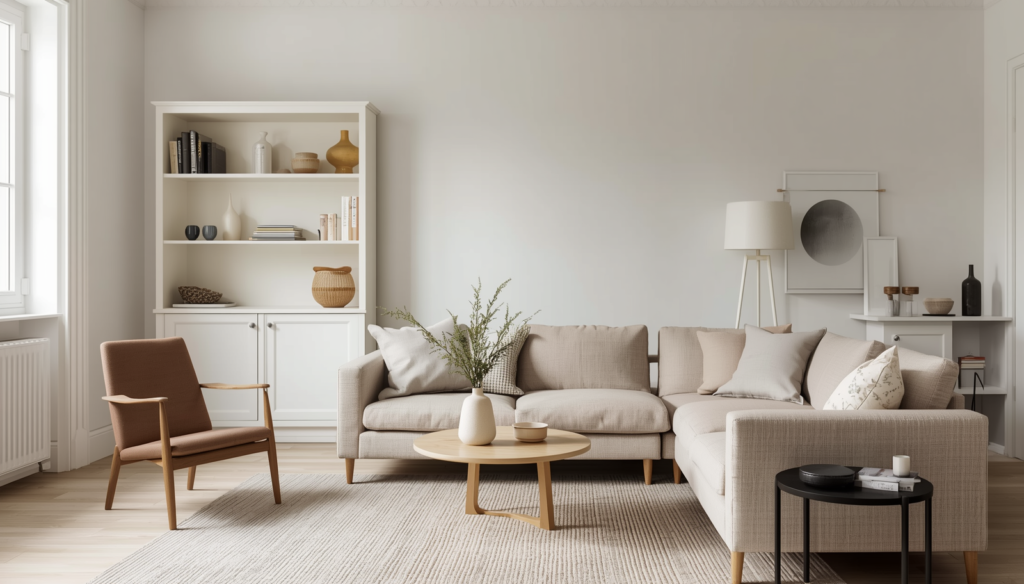
The result is a style that feels effortlessly put together — clean lines, warm natural materials, a palette of soft neutrals and the quiet confidence of a room that knows exactly what it is.
The Design Museum in London has documented the profound influence of Scandinavian design on British interiors — and that influence is visible everywhere from the high street to the finest independent design studios.
The British twist on Scandi minimalist style
Pure Scandinavian minimalism can sometimes feel a little austere — beautiful but slightly cold. The British version is warmer and more personal. It keeps all the clean lines and natural materials of the original but adds a little more texture, a little more warmth and occasionally a little more personality.
So a pure Scandi living room might have white walls, pale wood and a single carefully chosen plant. The British Scandi version adds a linen throw in warm oatmeal, a small collection of ceramics on an open shelf and perhaps a framed botanical print on the wall. It’s still minimal. But it’s minimal in a way that feels genuinely liveable rather than aspirationally sparse.
This is the version we celebrate at The Great British Nook. And it’s the version that works most beautifully in American homes.
A brief history of Scandi minimalist design
Scandinavian design as a distinct movement emerged in the early twentieth century — shaped by a commitment to democratic design, honest materials and the belief that beautiful, well-made objects should be available to everyone rather than just the wealthy.
The great names of mid-century Scandinavian design — Alvar Aalto, Arne Jacobsen, Hans Wegner — created furniture and objects that were simultaneously functional and breathtakingly beautiful. Their work established the visual language that Scandi minimalist home decor still speaks today.
In Britain, Scandinavian design found a natural home. The British already shared many of the same values — a love of craftsmanship, an appreciation for natural materials and a deep suspicion of unnecessary ornamentation. Furthermore, the concept of hygge — the Danish art of cosiness and contentment — resonated immediately with a nation that had always taken its home comforts seriously.
Together the two traditions created something genuinely special. And American homeowners have been drawn to it ever since.
What is hygge and why does it matter?
No guide to Scandi minimalist home decor would be complete without addressing hygge. It’s one of those concepts that’s difficult to translate precisely — but easy to recognise when you feel it.
Hygge is the Danish art of cosiness and contentment. It’s the feeling of being warm inside while it’s cold outside. Of candlelight on a dark evening. Of a good book and a warm drink and a soft blanket. Above all, it’s the feeling of being genuinely at home.
In design terms, hygge translates into warm lighting, soft textures, natural materials and a home that prioritises comfort and atmosphere over perfection and impressiveness. It’s the quality that separates a Scandi minimalist interior that feels cold and empty from one that feels serene and deeply inviting.
So when you’re making decisions about your Scandi minimalist home decor, always ask yourself — does this add to the feeling of hygge? Does it make the room warmer, softer and more inviting? If yes, it belongs. If not, think carefully before including it.
The Scandi minimalist color palette
Color in a Scandi minimalist interior is soft, warm and deliberately restrained. Here’s what to focus on.
Warm white and soft cream are your base colors. Not brilliant white — something warmer and more natural. Think of the color of unbleached linen or fresh plaster. Use it on walls, large furniture pieces and curtains to give the room its characteristic light and airiness.
Warm grey and greige — the particular grey-beige that sits at the heart of the Scandi minimalist palette. Neither too warm nor too cool, it works beautifully as a secondary neutral on rugs, upholstery and accessories.
Natural wood tones in pale oak, ash and birch. These warm honey and pale golden tones are the most important color in a Scandi minimalist interior after white — they bring warmth, life and the essential connection to the natural world that defines this style.
Soft sage and dusty green as a gentle accent. A single sage green plant pot, a dusty green cushion or a soft green ceramic vase adds just enough color to stop the palette feeling flat. Furthermore, green connects the interior to the natural world in a way that feels entirely consistent with Scandi minimalist values.
Charcoal and soft black used sparingly as an anchoring accent. A black picture frame, a charcoal throw, a dark ceramic accessory — these small dark accents stop a Scandi minimalist room from feeling too sweet or too soft.
Above all, resist the temptation to add too many colors. The restraint of the Scandi minimalist palette is what gives it its power. Every color you add beyond these five should earn its place very carefully.
The key textures of Scandi minimalist home decor
Texture is where a Scandi minimalist interior finds its warmth. Without texture, the clean lines and neutral palette can feel empty. With the right textures, the same room feels serene and deeply inviting. So here’s what to focus on.
Undyed linen is your most important fabric. Use it everywhere — curtains, cushions, throws and sofa covers. Slightly rumpled, completely natural and warm to the touch, undyed linen is the defining fabric of Scandi minimalist style. It brings texture without pattern and warmth without color.
Pale oak and ash wood throughout. Furniture, shelving, flooring and accessories — pale Scandinavian wood tones bring the natural warmth that stops a minimalist interior feeling cold. Look for pieces with a simple, honest construction rather than decorative detail.
Wool and sheepskin for warmth and texture. A sheepskin draped over a chair, a wool throw on the sofa, a wool rug underfoot — these natural animal fibers add the most primal and instinctive sense of warmth and comfort to a Scandi minimalist room.
Matte ceramic and stoneware in simple, organic shapes. Handmade pottery, simple stoneware mugs and unglazed ceramic vases all belong in a Scandi minimalist interior. They bring the imperfect, human quality that stops a minimal room feeling machine-made.
Concrete and stone as occasional accent materials. A concrete planter, a stone soap dish, a slate trivet — these hard, cool materials work beautifully alongside the softer textures of linen and wool, adding contrast and the sense of honest, elemental materials working together.
The key pieces that define the look
Here are the pieces that do the most work in a Scandi minimalist interior.
A pale oak or ash dining table or coffee table is your most important furniture investment. Simple in form, honest in construction and beautiful in the way that only genuinely well-made wooden furniture can be. Look for clean lines and minimal ornamentation — the beauty should be entirely in the wood and the making.
A simple linen sofa or sofa cover in warm white, oatmeal or soft grey. The linen sofa is to Scandi minimalist style what the velvet sofa is to traditional British style — the defining piece around which everything else is arranged. Furthermore, a quality linen sofa cover is a surprisingly effective and affordable way to achieve the look without replacing your existing sofa.
A statement ceramic or stoneware lamp base with a simple linen shade. Lighting is crucial in a Scandi minimalist interior and a beautiful handmade ceramic lamp base does double duty as an accessory and a light source. Above all, always use warm bulbs — cool white light destroys the hygge quality of a Scandi minimalist room instantly.
A sheepskin or wool rug in natural, undyed tones. A genuine sheepskin draped over a chair or a natural wool rug underfoot is one of the most effective and affordable ways to bring warmth and texture to a Scandi minimalist room.
A collection of simple ceramic and glass vessels in organic shapes. A single stem in a simple glass bottle, a handmade ceramic vase with a dried grass arrangement, a stoneware bowl on the kitchen shelf — these quiet, beautiful objects are the jewellery of a Scandi minimalist interior.
How to bring Scandi minimalist home decor into an American home
Scandi minimalist home decor is one of the most accessible styles you can attempt — but it requires a discipline that not everyone finds easy. Here’s how to approach it successfully.
Start by editing rather than adding. Go through your current room and remove anything that doesn’t earn its place — anything that’s neither beautiful nor useful. This editing process is uncomfortable but transformative. Above all, be ruthless. The magic of Scandi minimalist style only works when there’s genuine breathing room between the things that remain.
Then start with your walls. Warm white gives you the right foundation. Add your pale wood — a shelf, a side table, a lamp base. Then layer your textures — a linen throw, a wool cushion, a sheepskin on a chair.
Finally add your accessories very sparingly. One beautiful ceramic vase. A single stem or a simple dried grass arrangement. A small stack of books with beautiful covers. That’s enough. Furthermore, resist the temptation to add more. The restraint is the point. And it takes genuine confidence to maintain it.
Ready to explore Scandi minimalist home decor?
Scandi minimalist home decor is one of the most rewarding styles you can bring into your home. It requires commitment and discipline — but the result is a space that feels genuinely calm, genuinely beautiful and completely your own.
At The Great British Nook, we’ve curated the very best Scandi minimalist home decor available on Amazon and shipped directly to your door. So whether you’re starting from scratch or simply editing a room you already love, we’ve got everything you need.
You might also love our complete guide to British coastal interior design — which shares Scandi minimalist style’s love of natural materials and honest, uncluttered spaces. Furthermore, if you’re drawn to the richer, more layered side of British design, our guide to traditional British interior design offers a wonderful contrast.
So take a breath. Clear a surface. And let’s find your calm.