May contain affiliate links. If you click through and make a purchase we may earn a small commission at no extra cost to you. Thank you for supporting The Great British Nook.
Traditional British interior design is one of the most enduring and admired design traditions in the world. It’s confident, layered and it’s full of the kind of quiet authority that only comes from centuries of getting it right. Furthermore, it has that extraordinary ability to feel simultaneously grand and completely liveable — a combination that very few other design traditions manage to pull off.
But what exactly is traditional British interior design? And how do you bring it into an American home without it feeling like a museum installation? That’s exactly what this guide is here to answer. So settle in. This is a style with a lot to say.
What is traditional British interior design?
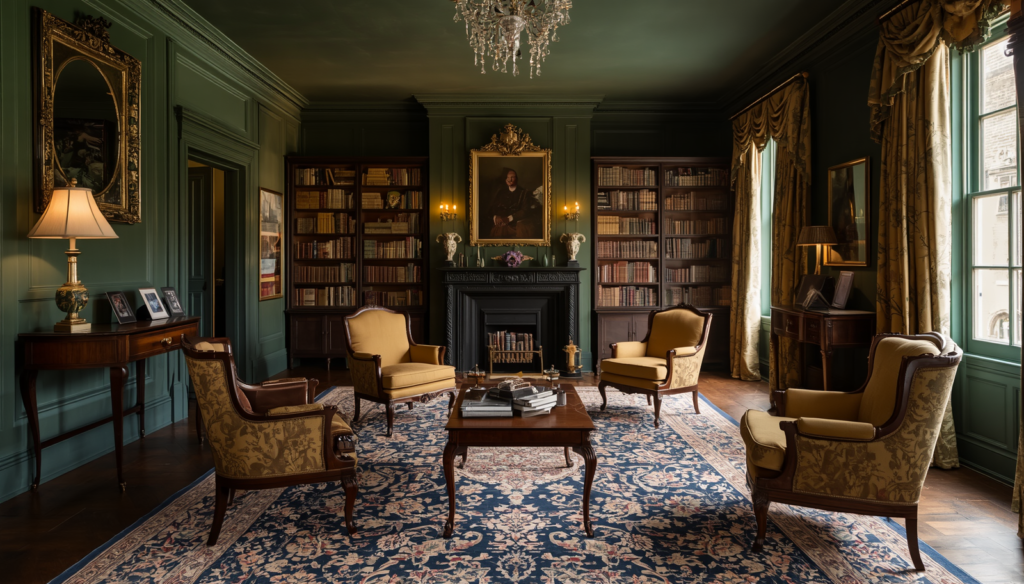
Traditional British interior design is a style rooted in the great houses, townhouses and country estates of Britain — the interiors that evolved over centuries of craftsmanship, collecting and the confident accumulation of beautiful things. Think the Georgian townhouse of Edinburgh’s New Town. The Regency drawing room of a Bath terrace. The library of an English country house lined floor to ceiling with leather-bound books. Above all, think of rooms that have absorbed generations of family life and look all the better for it.
The result is a style that feels deeply considered without feeling contrived. It mixes periods and styles with confidence — an antique Persian rug beneath a modern sofa, a Georgian portrait above a contemporary fireplace. Furthermore, it prioritises quality above all else. Traditional British interior design is built on pieces chosen to last a lifetime rather than a season.
The Victoria and Albert Museum holds one of the world’s greatest collections of British decorative arts — and their permanent galleries remain one of the finest sources of inspiration for traditional British interior design anywhere in the world.
A brief history of traditional British interior design
Traditional British interior design as we know it today was shaped by several great periods of British design history.
The Georgian period of the eighteenth century gave us the elegant proportions, classical symmetry and restrained ornamentation that still define the most admired British interiors. Georgian rooms are characterised by their perfect balance — tall sash windows, high ceilings, plasterwork cornicing and a palette of warm whites, soft greys and deep Georgian greens.
The Regency period of the early nineteenth century added more drama and more colour. Deeper jewel tones, more elaborate pattern, more decorative confidence. The Regency interior is warmer and richer than its Georgian predecessor — full of the bold chinoiserie prints, rich silks and lacquered furniture that Regency designers loved.
The Victorian period brought maximalism in its fullest expression. Pattern on pattern, surface on surface, object upon object. Victorian interiors are the richest and most layered of all British design periods — and they’re the direct ancestor of the traditional British interior we know and love today.
The Edwardian period simplified things slightly — lighter colors, more naturalistic patterns, a little more breathing room — while retaining all the quality and craftsmanship of what came before.
Together these four great periods created a design tradition of extraordinary richness and depth. And American homeowners have been drawing on it for inspiration ever since.
The traditional British interior design color palette
Color is where traditional British interior design makes its boldest statement. So here’s what to focus on.
Deep heritage greens are perhaps the most iconic color of traditional British interior design. Think of the particular dark green of a Georgian library — rich, slightly dark and completely commanding. Farrow & Ball’s Calke Green or Studio Green are perfect references. Use it on walls for maximum impact or on a single accent wall if you want something less dramatic.
Rich navy and indigo bring depth and sophistication to a traditional British scheme. A navy library, a deep indigo drawing room — these are some of the most beautiful rooms in British interior design history. Furthermore, navy works brilliantly as an accent color throughout a room — on cushions, curtains and upholstery.
Warm red and burgundy in the deeper, more muted tones of an aged Persian rug rather than a bright pillar box red. These warming tones add drama and richness without overwhelming a room.
Soft Georgian white and warm cream for ceilings, cornicing and architectural details. These lighter tones balance the deeper wall colors and give a traditional British room its characteristic sense of elegant contrast.
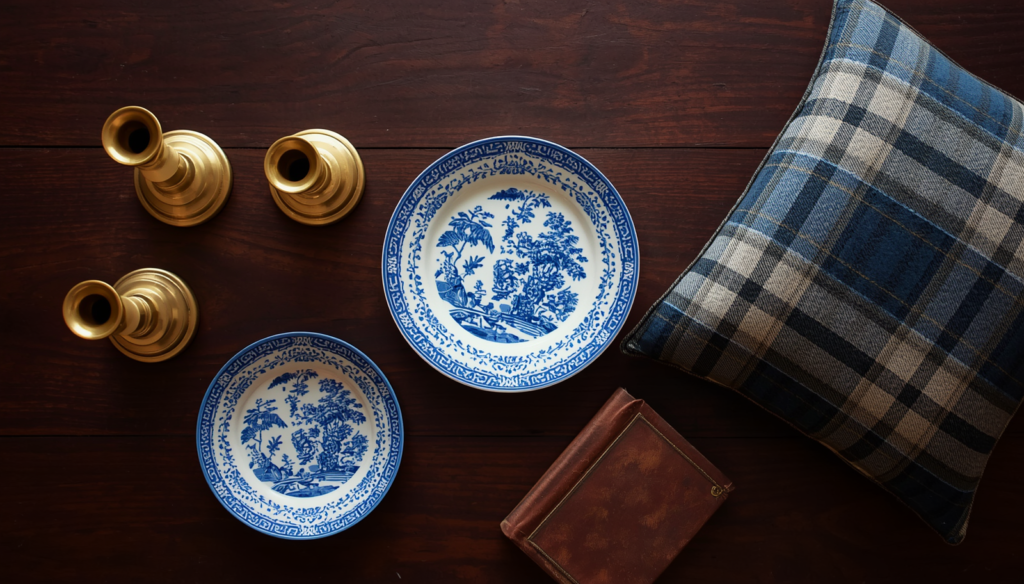
Gold and warm brass as your metallic accent. Brass picture frames, gilt mirror frames, bronze lamp bases — warm metallics are the jewellery of a traditional British interior. Above all, avoid silver and chrome — they’re too cold for this style.
The key textures of traditional British interior design
Texture in a traditional British interior is rich, layered and completely unapologetic. Here’s what to focus on.
Wool and silk upholstery fabrics in rich patterns — damask, brocade, velvet and tweed. These are the signature fabrics of traditional British interior design and they bring a depth and richness that no other fabrics can match. A velvet sofa in deep teal or a damask armchair in warm burgundy is one of the most impactful investments you can make.
Persian and Oriental rugs on wooden floors. A good antique or vintage style rug is the foundation of a traditional British room. It brings color, pattern and the sense of history that defines this style. Furthermore, it connects all the other elements of the room — anchoring the furniture and tying the color palette together.
Heavy cotton and linen curtains in rich patterns — toile de Jouy, chinoiserie, classic floral or simple stripe. Traditional British windows are dressed rather than simply covered. Full length curtains in a quality fabric with a generous amount of gather make an enormous difference to how a room feels.
Dark wood furniture in mahogany, walnut and aged oak. The furniture of a traditional British interior has weight and presence. It’s built to last and designed to improve with age. Look for pieces with genuine character — slight imperfections, a patina that speaks of years of polish and care.
Books. In a traditional British interior, books are not decoration — they’re a fundamental design element. Floor to ceiling bookshelves lined with well-read books are as important to the traditional British interior as any piece of furniture. Above all, they should look genuinely read rather than carefully arranged for effect.
The key pieces that define the look
Here are the pieces that do the most work in a traditional British interior, and also see 10 Best Traditional British Home Accessories article:
A velvet or damask sofa in a deep jewel tone is your most important investment. Deep teal, rich burgundy or warm forest green — choose a color you love and commit to it. Furthermore, quality upholstery fabric only gets more beautiful with age so this is worth investing in properly.
A Persian or Oriental style rug in warm jewel tones. This is the foundation of the whole room. Choose one with genuine complexity — multiple colors and a detailed pattern — and let it guide the rest of your color decisions.
A brass or gilt mirror above the fireplace or on a key wall. Large, slightly ornate and warm in tone — this is one of the most transformative and surprisingly affordable pieces you can add to a traditional British room.
Toile de Jouy or chinoiserie cushions and curtains. These deeply British patterns add instant period character to any room. Used confidently they signal that the room has a genuine design point of view rather than simply being furnished.
A collection of framed portraits or landscapes. Traditional British rooms are hung with art — not decorative prints but proper paintings or high quality art prints in substantial frames. A gallery wall of framed portraits above a sofa is one of the most dramatic and characterful things you can do to a traditional British room.
How to bring traditional British interior design into an American home
Traditional British interior design translates beautifully into American homes — perhaps more easily than you might expect. Here’s how to approach it.
Start with your walls. A deep heritage green or rich navy immediately establishes the traditional British mood. If full wall color feels too bold, start with a single accent wall — behind a sofa or fireplace is ideal.
Add your rug next. A good Persian or Oriental style rug is the single most transformative purchase you can make. It instantly grounds the room and gives you a color palette to build everything else around.
Then layer your soft furnishings. Rich cushions, heavy curtains and a quality throw in complementary jewel tones. Above all, don’t be afraid of pattern. Traditional British interior design mixes patterns with confidence — a toile cushion with a stripe throw, a damask armchair with a floral rug. If the colors connect, the patterns will work together.
Finally, add your accessories. Brass accents, framed artwork, a collection of books on a shelf, a ceramic lamp with a linen shade. These finishing touches are what give a traditional British interior its irreplaceable sense of depth and character.
Ready to explore traditional British interior design?
Traditional British interior design is one of the most rewarding and characterful styles you can bring into your home. It rewards investment, improves with age and becomes more beautiful the more it accumulates the marks and memories of a life well lived.
At The Great British Nook, we’ve curated the very best traditional British home decor available on Amazon and shipped directly to your door. So whether you’re starting from scratch or adding the finishing touches to a room you already love, we’ve got everything you need.
You might also love our complete guide to British country cottage style — which shares traditional British design’s love of pattern, quality and the confident accumulation of beautiful things. Furthermore, if you’re drawn to the more relaxed side of British design, our guide to British coastal interior design is a wonderful place to start.
So pull up a wingback chair. Pour something warming. And let’s find your traditional British style.